

- Review
Harness Domestic Resources to Stem the ¥38 Trillion Outflow of National Wealth
September 18, 2026
|
KEY TAKEAWAYS |
Improving the Terms of Trade
Japan’s three lost decades following the collapse of the bubble economy have been marked by shrinking domestic investment, stagnant GDP growth, and declining real wages. The 2026 Basic Policy on Economic and Fiscal Management and Reform (Honebuto Policy), approved by the cabinet on July 21, 2026, aims to reverse this trajectory by simultaneously building a “strong economy” and ensuring “fiscal sustainability.” Central to this effort is improving Japan’s terms of trade.
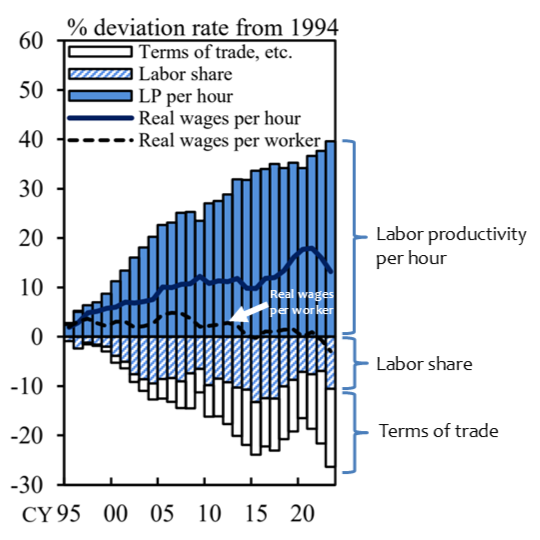
Conventional wisdom holds that in an era of demographic decline—where people requiring support outgrows the working-age population—maintaining economic growth rests on raising labor productivity. Japanese workers have indeed delivered: between the mid-1990s and mid-2020s, hourly labor productivity rose by roughly 40 points. Yet real wages did not rise; they fell (Figure 1).
Figure 1. Decomposition of Real Wages per Hour (All Industries)
 Source: Bank of Japan Working Paper Series, “Potential Growth in Japan: Issues on Its Relationship with Prices and Wages” (December 2024). Excerpted and partially augmented by the author from Figure 17 on p. 26.
A major reason for this is Japan’s deteriorating terms of trade, calculated as the ratio of export prices to import prices. While productivity climbed, the terms of trade moved sharply in the opposite direction, offsetting gains in real wages (Figure 1). Japan earns foreign currency by exporting such goods as automobiles and advanced semiconductor manufacturing equipment but must spend more to import fossil fuels, mineral resources, and other essential materials. The result is a structural inability to retain the fruits of productivity improvements.
Recent data underscores the challenge. The Ministry of Finance reported on July 22 that Japan recorded a trade deficit of ¥1.01 trillion for the first half of 2026—its tenth consecutive half‑year deficit.[1] Firms facing persistent deficits cannot easily raise wages, especially under pressure from activist shareholders, and labor’s share of income inevitably declines.
Japan’s self‑image as a resource-poor country reinforces this vulnerability. In 2024, imports of fossil fuels and major mineral raw materials totaled approximately ¥38 trillion—a massive outflow of national wealth. Without addressing this structural dependence, improving the terms of trade and building a “strong economy” will remain out of reach (Figure 2).
Figure 2. Japan’s Imports of Fossil Fuels and Major Raw Materials
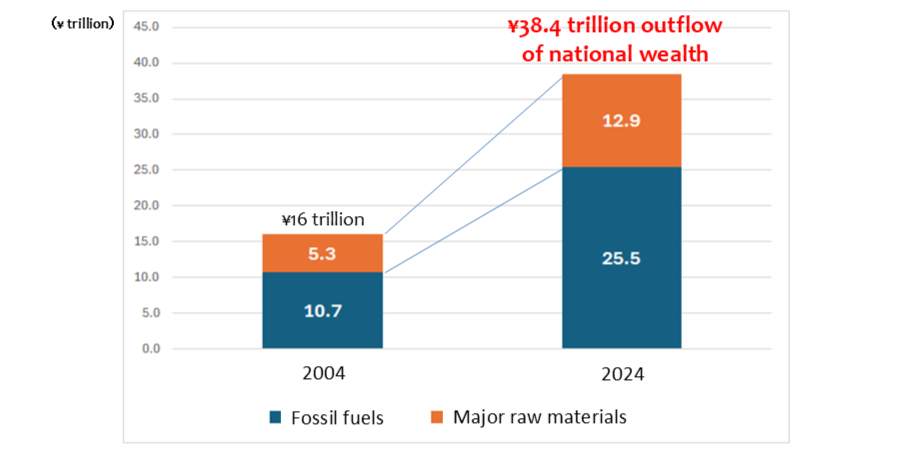 Source: Compiled by the author based on the Ministry of Finance’s balance of payments statistics from fiscal 2004 and 2024. (“Major raw materials” refer to nonferrous metal ores and iron and steel, along with raw-material-based products excluding non-furniture wood products.)
Japan’s Hidden Resources
Despite the common refrain that Japan lacks resources, the country possesses a wide array of domestic assets capable of improving the terms of trade.
Renewable Energy
Japan’s renewable energy potential exceeds twice its annual electricity consumption.[2] Variability due to weather—often cited as a weakness—can be mitigated through advanced ICT solutions such as vehicle-to-grid (V2G) systems, which integrate electric vehicles into the power grid to smooth fluctuations.[3] Studies show that V2G can significantly reduce balancing costs, making renewables competitive with conventional power sources.[4]
Renewables can also produce fuel. Through power-to-gas (P2G) electrolysis, renewable electricity can generate green hydrogen, which can be injected into existing natural gas pipelines or used to power fuel-cell vehicles.
Marine Mineral Resources
Japan’s surrounding seas contain substantial seafloor mineral deposits. Estimates suggest that offshore areas contain more than 75 years’ worth of domestic cobalt consumption and over 11 years’ worth of nickel. Rare earth elements—critical for advanced manufacturing—are also present in large quantities, with waters near Minamitorishima reported to hold deposits on a scale comparable to the world’s third‑largest reserves. Surveys have confirmed the presence of vast methane‑hydrate deposits in the eastern portion of the Nankai Trough, stretching from Suruga Bay to off the Miyazaki coast—equivalent to roughly six years of Japan’s liquefied natural gas imports (2021 levels).
Urban Mines
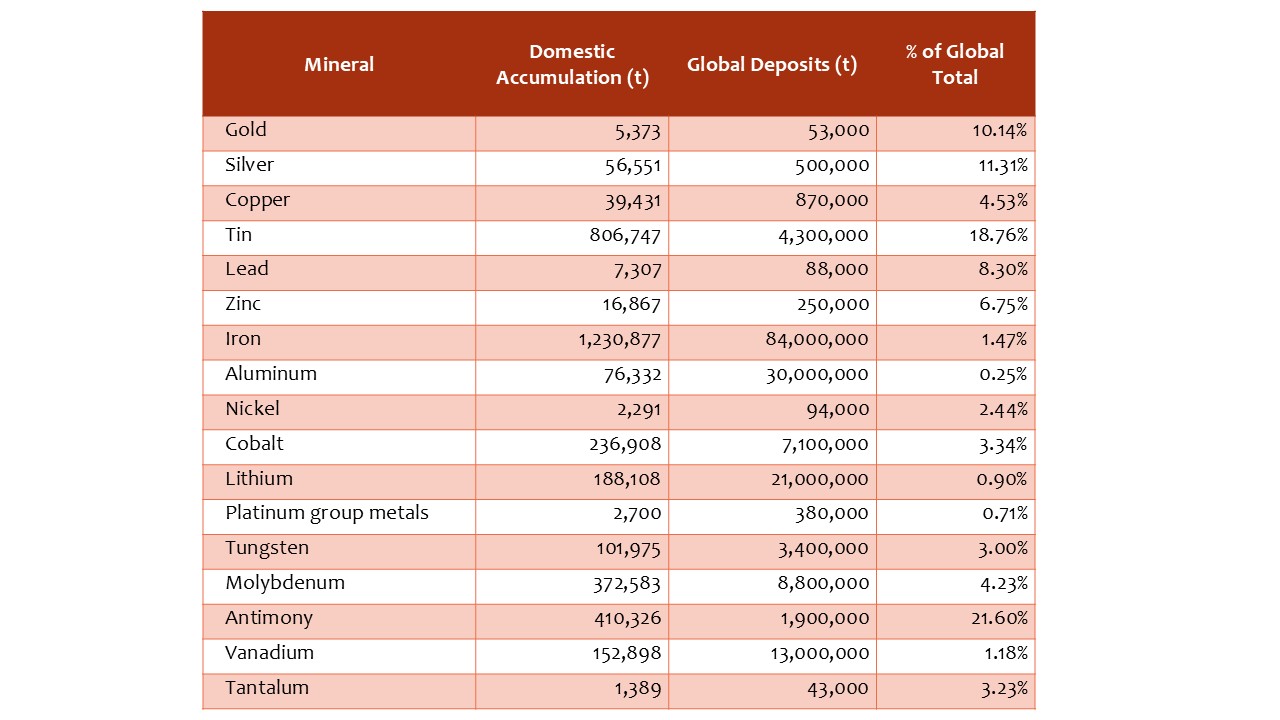
Japan’s urban mines—accumulated waste containing recoverable metals—represent enormous resource reserves. Such deposits hold approximately 410,000 tons of antimony, representing 22% of global underground reserves; 810,000 tons of tin (19% of the global total); 60,000 tons of silver (11%); and 5,000 tons of gold (10%)—exceeding the underground reserves of major gold-producing countries in Africa and elsewhere (Figure 3).
Plastic waste also represents a major opportunity: of the 8.24 million tons generated in 2021, only about 20% was recycled.[5] Expanding recycling would yield substantial domestic feedstock.
Figure 3. Examples of Japan’s Urban Mining Accumulation (2020)
Source: Created by the author using data from the Sustainability Design Institute, Japan’s Urban Mining Accumulation 2020.
Japan’s Technological Resources
Japan’s technological capabilities are themselves a valuable asset. Japan introduced the world’s first mass-produced electric vehicle in 2010, making EVs a technological resource developed domestically. In cutting-edge fields such as photonics-electronics convergence, Japanese firms are global leaders. Amid growing concerns over surging power consumption driven by the expansion of data centers, NTT has developed what it calls an Innovative Optical and Wireless Network (IOWN), which enables computers to operate using only one‑eighth the power of conventional systems; its long‑term goal is to reduce consumption by a factor of 100.[6]
These technologies should be actively utilized as strategic domestic resources.
Strengthening Economic Security
Active utilization of domestic resources can mitigate economic security risks, such as rare‑earth supply disruptions and fossil‑fuel chokepoints like the Strait of Hormuz.
Japan has already demonstrated leadership in rare‑earth recycling: in 2012, a Japanese automaker teamed up with a chemical manufacturer to jointly establish the world’s first mass-production recycling process for extracting rare earths from end-of-life products.[7] Such initiatives can enable manufacturers to source rare earths domestically.
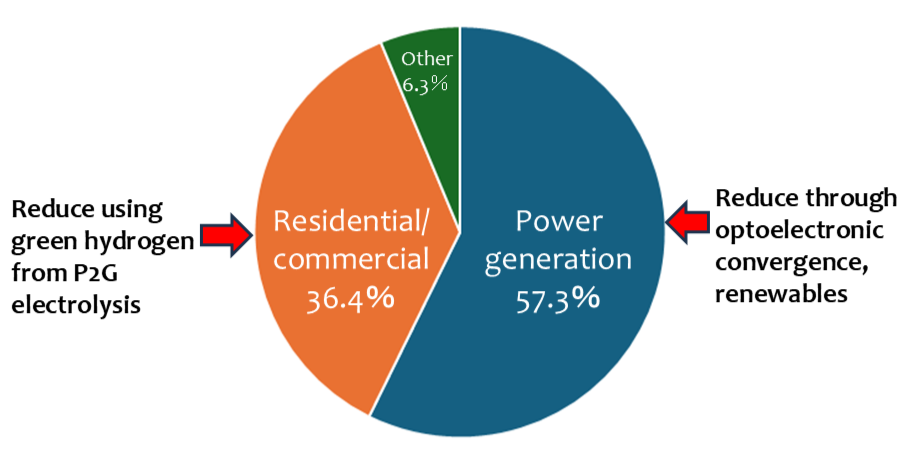
Fossil‑fuel vulnerabilities can also be reduced. In 2021, 57.3% of Japan’s natural gas consumption was for power generation, 36.4% for residential and commercial use, and 6.3% for other applications. Demand in the power sector can be substantially reduced by shifting to domestic renewable energy and by deploying Japan’s high-efficiency, energy-saving technologies. And expanding the use of green hydrogen produced from renewable energy would likewise reduce natural‑gas demand in the residential and commercial sectors (Figure 4).
Figure 4. Breakdown of Japan’s Natural Gas Consumption by Use (Fiscal 2021)
 Source: Created by the author based on data from the JOGMEC website.
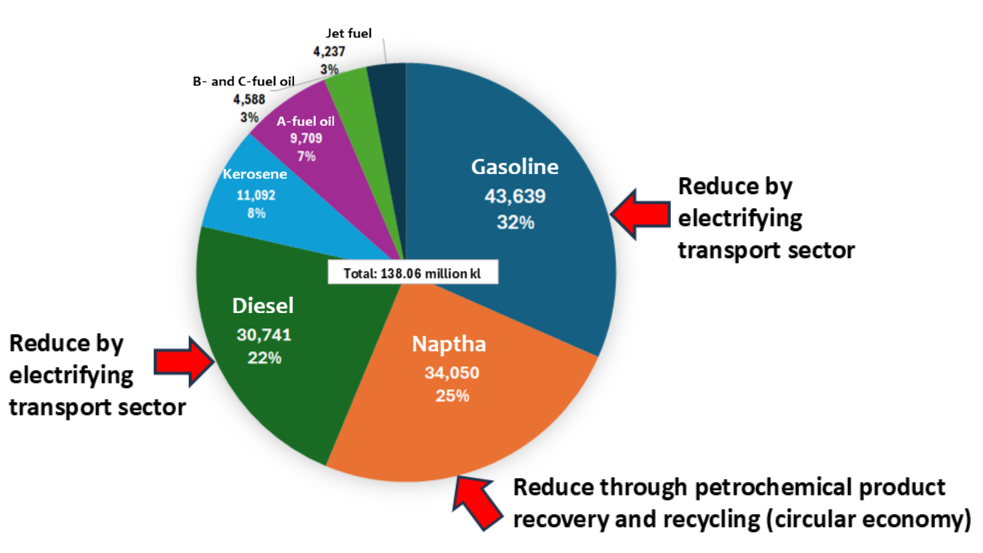
In 2024, the largest shares of Japan’s oil consumption were gasoline (32%), naphtha (25%), and diesel (22 %). Because gasoline and diesel are used primarily in the auto transport sector, replacing conventional internal‑combustion vehicles with electric vehicles and fuel-cell vehicles, both of which draw on Japan’s technological strengths, could theoretically reduce national oil demand by more than half.
More than 60% of naphtha demand is attributable to plastics.[8] Expanding the recovery of waste plastics from Japan’s urban mines and securing recycled plastic feedstock would thus allow for a substantial reduction in naphtha consumption (Figure 5).
Taken together, these measures demonstrate how proactive utilization of domestic resources can reduce Japan’s dependence on imported materials and support the development of a resilient economy capable of withstanding key economic‑security risks.
Figure 5. Domestic Demand for Petroleum Products (Fuel Oils) in Japan (Fiscal 2024)
 Source: Created by the author using data from the Petroleum Association of Japan, Petroleum Industry in Japan 2025.
A Proposal Presented to Minister Akazawa
Japan’s national strength declined during the so-called three lost decades. Actively mobilizing domestic resources would redirect the ¥38 trillion currently flowing overseas back into the Japanese economy, improving terms of trade, and contributing to higher real wages.
At the same time, reducing dependence on imported resources would strengthen Japan’s resilience against economic‑security risks associated with rare‑earths and shipments through the Strait of Hormuz. Utilizing recycled materials recovered from Japan’s urban mines is far more carbon‑efficient than using virgin, underground resources, making it an effective strategy for addressing climate change and accelerating decarbonization.
Countries worldwide are rapidly advancing circular‑economy initiatives in which recycled resources circulate through supply chains and support economic activity. Europe has begun mandating minimum recycled‑content in manufactured products. The global circular‑economy market is projected to grow from $4.5 trillion in 2030 to $25 trillion by 2050,[9] intensifying competition for market share.
Against this backdrop, the author met with Minister of Economy, Trade, and Industry Ryosei Akazawa on March 31 to present two proposals aimed at eliminating the ¥38 trillion in national‑wealth outflows caused by resource dependence. (See Turning Waste into Wealth: Japan’s ¥13 Trillion Opportunity.)
During the meeting, Minister Akazawa stated that active utilization of domestic resource is essential for advancing the circular economy and expressed his intention to incorporate the recommendations into Japan’s growth strategy and the government’s 2026 Honebuto Policy. On April 21, the government adopted a circular economy action plan, which includes elements from these proposals. This was integrated into the 2026 Honebuto Policy (p. 10), committing Japan to strengthening supply chains for recycled resources through strategies such as metal recycling.
Moving forward, the project on Building a Resource and Energy Recycling Society will focus on ensuring that the circular‑economy commitments in the action plan and Honebuto Policy lead to real-world impact rather than remaining aspirational.
Notes
[1] Ministry of Finance, “Hodo happyo: Reiwa 8-nen kamihanki-bun boeki tokei (sokuho) no gaiyo” (Press Release: Overview of Preliminary Trade Statistics for the First Half of Fiscal 2026), July 22, 2026.
[2] Ministry of the Environment, Climate Change Policy Division, “Japan’s Renewable Energy Introduction Potential (Summary),” April 2022.
[3] Center for Low Carbon Society Strategy, “Symposium 2018 on a Bright and Prosperous Low‑Carbon Society in 2050”; and Hiromi Asahi, “Realizing Decarbonization in 2050 and Society 5.0: Considerations from the Perspective of an Automaker,” Nissan Motor Co., Ltd., December 12, 2018.
[4] Ministry of Economy, Trade, and Industry, “Report on Verification of Power Generation Costs for the Strategic Policy Committee,” 67th Meeting of the Strategic Policy Committee of the Advisory Committee for Natural Resources and Energy, December 17, 2024, 188.
[5] Ministry of Economy, Trade, and Industry, “Purasuchikku Shigen Junkan Sokushin-Ho no seko jokyo to seicho shiko no shigen jiritsu keizai senryaku” (Status of Enforcement of the Act on Promotion of Plastic Resource Circulation and Growth-Oriented Resource Autonomous Economy Strategy), November 2023.
[6] NTT R&D, “Innovation in Computing Powered by Photonic Technology—Evolution toward IOWN 2.0 and 3.0, and the Leap to Quantum.”
[7] Honda Motor Co., “Honda to Reuse Rare Earth Metals Contained in Used Parts,” news release, April 17, 2012.
[8] Japan Petrochemical Industry Association, “Sekiyu kagaku seihin no juyo bunpu” (Distribution of Demand for Petrochemical Products).
[9] Ministry of Economy, Trade, and Industry, “Shigen junkan keizai seisaku no genjo to kadai ni tsuite” (Current Status and Challenges of Resource Circulation Economy Policy), September 2023,
-
-

- RESIDENT FELLOW
- Hikaru Hiranuma
- Hikaru Hiranuma
- Areas of Expertise
-
- Natural resources and energy issues
- environment
- Research Project
- Past Research
-
- The Blue Economy: International Trends and the Situation in Japan ( –2021)
- Japan’s Response to an Accelerating Global Energy Transition (2021–2022)
- Advancing Renewable Energy Initiatives through Local Ownership(-2024)
- The Blue Economy: International Trends and the Situation in Japan—A Follow-Up(-2025)
- Japan’s Response to an Accelerating Global Energy Transition—A Follow-Up(-2025)
- Measures Necessary to Build a Circular Economy Society(-2025)
-

Featured Content
-
Haiku: The Heart of Japan in 17 Syllables
Haiku: The Heart of Japan in 17 Syllables
-
Japan’s Population Decline and the Gijinkoku Visa’s Pathway to Settlement without Adequate Screening
Japan’s Population Decline and the Gijinkoku Visa’s Pathway to Settlement without Adequate Screening
-
Funding the Policies to Boost Japan’s Birthrate
Funding the Policies to Boost Japan’s Birthrate
-
Addressing the Problems in the Japanese Healthcare System
Addressing the Problems in the Japanese Healthcare System
-
Rice Grown in Rice Terraces
Rice Grown in Rice Terraces


