
- Policy Proposal
Turning Waste into Wealth: Japan’s ¥13 Trillion Opportunity
March 31, 2026
The Tokyo Foundation Proposes a Circular Economy Strategy to Halt National Wealth Outflows
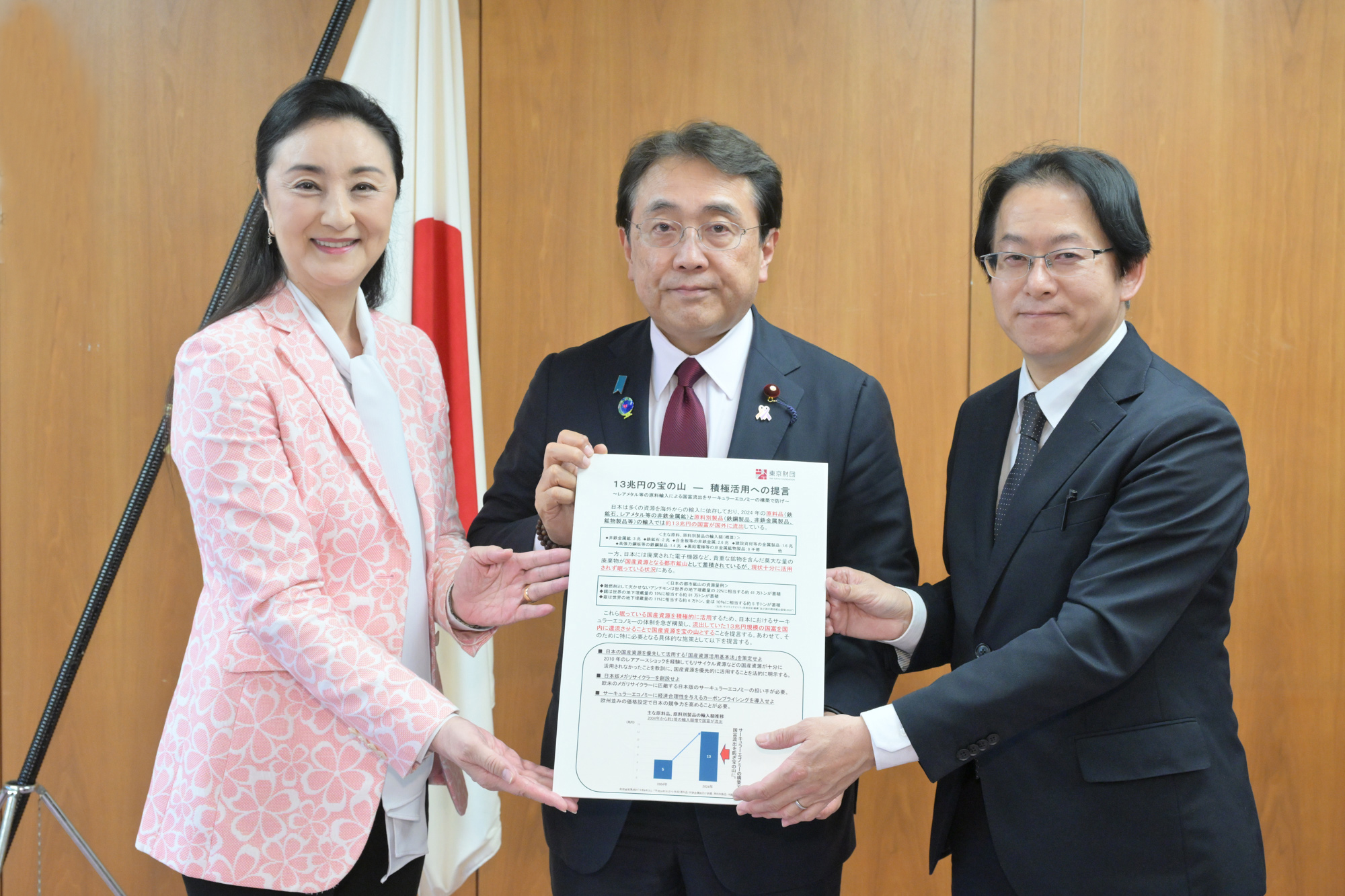
The Tokyo Foundation presented “A Policy Proposal for Proactive Utilization of a ¥13 Trillion Treasure Trove,” calling for large-scale utilization of domestic resources, to Ryosei Akazawa, minister of economy, trade, and industry, at the Ministry of Economy, Trade, and Industry on Tuesday, March 31, 2026.
The proposal outlines a comprehensive domestic resource strategy from the perspective of economic security, calling for the large-scale utilization of waste accumulated within Japan—so called urban mines—as a key pillar of a Japanese-style circular economy. By doing so, it aims to curb the massive outflow of national wealth caused by Japan’s dependence on imported mineral resources and to build a new foundation for strong, sustainable economic growth.
The briefing also highlighted that the outflow of national wealth from dependence on overseas resources—including fossil fuel imports, in addition to mineral resources—amounts to approximately ¥38 trillion (2024),[2] and also presented "A Policy Proposal for Proactive Utilization of a ¥38 Trillion Treasure Trove." Japan currently relies heavily on overseas sources for mineral resources. In fiscal year 2024 alone,[1]imports of mineral-related raw materials and processed goods resulted in an estimated ¥13 trillion outflow of national wealth, exacerbating Japan’s unfavorable terms of trade and constraining real wage growth.
Recent geopolitical developments—most notably renewed supply constraints surrounding rare earths amid growing US-China trade tensions—have once again highlighted the economic security risks inherent in this dependence. Against this backdrop, the Tokyo Foundation’s proposal argues that Japan should recognize the treasure trove of valuable minerals embedded in discarded electronics and other domestic waste already present within the country and calls for full-scale utilization of domestic urban mining resources.
One research theme of the Tokyo Foundation is building a circular society as a means of transitioning to a new social system amid population decline. This research pursues data-driven, rational, and realistic solutions.
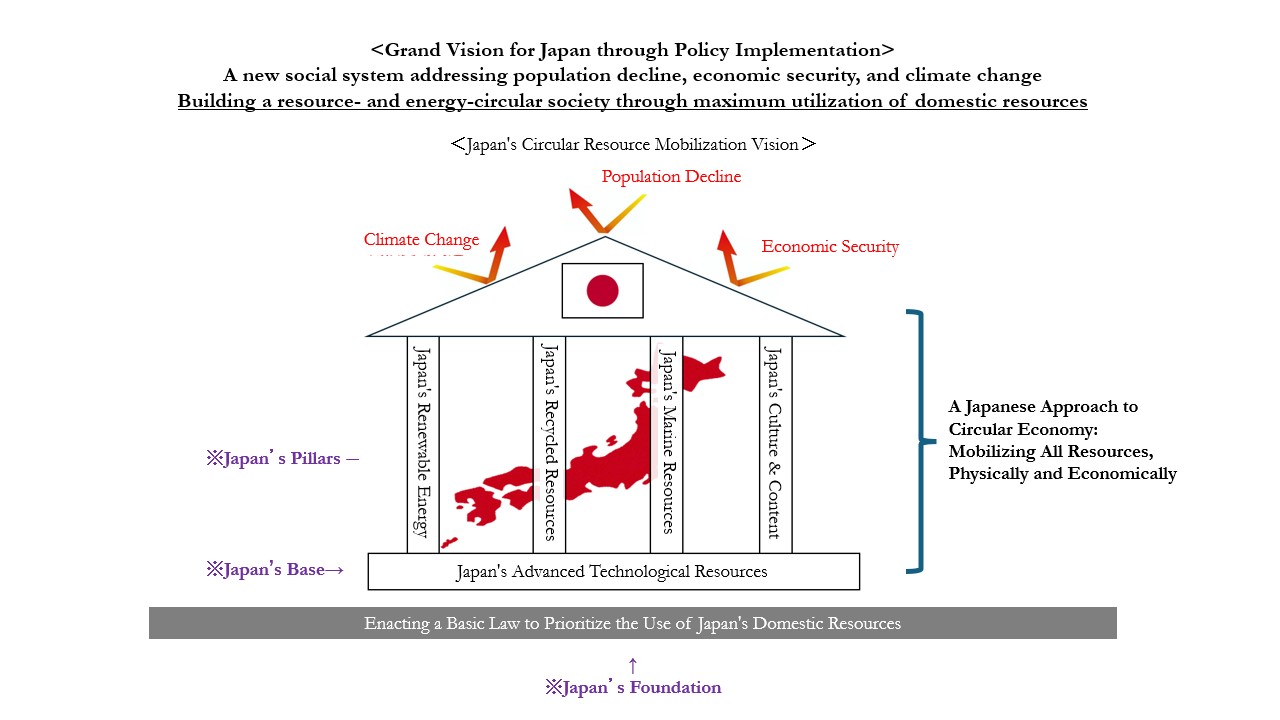
The proposal positions Japan’s urban mines, marine resources, renewable energy, and advanced technologies as abundant domestic resources, and calls for the building of a distinctly Japanese-style circular economy—one that circulates and utilizes all domestic resources—to address the challenges of population decline, economic security, and climate change. It presents a vision for transforming the Japanese archipelago into a self-sufficient domestic resource base by improving the self-sufficiency rate for resources and energy.
When delivering the proposal, President Nakabayashi explained that it reflects the Foundation’s role as an independent, nonprofit think tank conducting long-term, unconstrained research and that it presents a concrete vision for a resource and energy circular society.
Minister Akazawa, upon receiving the document, said, “Utilizing domestic resources is important from the perspective of the circular economy, and I will strive to incorporate the recommendations into the government's growth strategy and the Basic Policy on Economic and Fiscal Management and Reform.”
Senior Fellow Hikaru Hiranuma, who compiled the policy proposal, then briefed the minister on the scale of national wealth outflows resulting from imports of mineral-related goods and emphasized the urgency of policy actions to reverse this trend. He pointed to three concrete priority measures, including the enactment of a Basic Law on Domestic Resource Utilization that would mandate the prioritization of domestic resources—such as urban mines—over imported ones.
A Policy Proposal for Proactive Utilization of a ¥13 Trillion Treasure Trove
Preventing the Outflow of National Wealth from Imports of Rare Metals and Other Raw Materials Through the Construction of a Circular Economy
-
-
While the declining population raises concerns about labor shortages weighing on the economy, building a sustainable society requires not only further improvements in labor productivity but also better terms of trade achieved by increasing the self-sufficiency rate for resources and energy. Japan has long considered itself “resource-poor” and relied heavily on imports for many resources, resulting in an enormous outflow of national wealth—an unfavorable terms-of-trade structure that is one of the primary factors behind stagnating real wages.
-
To reduce the outflow of national wealth and raise real wages, Japan must reform its existing social system—built on dependence on imported resources—and transition to a new social system that actively leverages domestic resources rather than relying on foreign ones, and that drives growth by deploying products and services with thorough value-added.
-
Dependence on imported resources not only suppresses growth in real wages but also creates economic security risks: surging fossil fuel prices driven by geopolitical instability and resource nationalism—such as China’s restrictions on rare earth exports—creating the threat of supply disruptions.
-
China’s renewed use of rare earths as a diplomatic card in the US-China trade war under the second Trump administration has once again underscored the serious economic security risks of depending on imports for mineral resource procurement.
-
Japan is also facing the challenge of securing sufficient fiscal resources for various policy priorities—including the estimated ¥5 trillion per year needed to eliminate the consumption tax on food—a measure that has gained attention as a means of raising household incomes. Against this backdrop, the fact that imports of mineral-related raw materials and processed goods resulted in an outflow of approximately ¥13 trillion of national wealth in 2024 makes reducing dependence on mineral resource imports an urgent priority.
-
Although Japan has long viewed itself as resource-poor, enormous amounts of discarded electronics and other waste—containing valuable minerals—are accumulating as urban mines that constitute a domestic resource base.
-
Yet despite the existence of various laws and regulations related to resource recycling, the recycling rate for e-waste (waste electrical and electronic equipment) and plastic waste stands at only around 20%, meaning that these valuable domestic resources are not being adequately utilized.
-
In response to this situation, this proposal aims to build a new, sustainable social system capable of functioning even as Japan’s population declines. It calls for the proactive utilization of Japan’s abundant urban mines—a domestic resource—to recirculate the ¥13 trillion in national wealth that has been flowing overseas and transform it into a treasure trove. To that end, it sets out three specific priority measures:
-
■Enact a Basic Law on Domestic Resource Utilization to prioritize the use of Japan’s domestic resources
Although a range of laws and regulations relating to resource recycling have been put in place, various recycling rates remain at approximately 20% (there are insufficient incentives to use recycled resources, leading businesses to procure virgin materials from the market).
At the time of the 2010 rare earth shock, a policy direction was set to promote rare earth recycling, yet adequate recycling has not been achieved in the years since.
Moreover, existing laws do not necessarily require the prioritization of recycled resources, cover only waste materials, and do not promote the utilization of other domestic resources. It is therefore necessary to enact a Basic Law on Domestic Resource Utilization—a higher-order law that explicitly mandates the priority use of domestic resources, including waste materials.
■Establish a Japanese-style mega-recycler
Realizing a circular economy that circulates and utilizes domestic resources requires a central actor to lead the effort.
In Europe, large-scale waste processing companies known as mega-recyclers play a central role as the key actors. A Japanese-style mega-recycler, adapted to Japan’s circumstances, should be established.
■Introduce carbon pricing to provide economic rationale for the circular economy
Recycled resources are indispensable for decarbonizing the raw materials component of TCFD Scope 3. Resource circulation through the circular economy is itself a decarbonization measure, and in Europe and other countries, carbon pricing serves as one of the mechanisms that makes the circular economy economically rational. While Japan has recently indicated projected upper and lower bounds for carbon prices, the level still lags behind Europe, and Japan needs to adopt European-level pricing to enhance its competitiveness.
The Need for a Resource and Energy Circular Society Through a Japanese-Style Circular Economy
-
Given that the outflow of national wealth from overseas resource dependence—encompassing fossil fuel imports as well as mineral resources—amounts to approximately ¥38 trillion (2024),[2] there is a need for policies that position domestic resources as a treasure trove. The government must urgently build a resource and energy circular society through a Japanese-style circular economy that physically and economically circulates all domestic resources—including urban mines, marine resources, renewable energy, and technological resources.
-
A Basic Law on Domestic Resource Utilization should be enacted as the “foundation” for prioritizing domestic resources. Advanced Japanese-origin technologies—such as electric vehicles (EVs), lithium-ion batteries, and optical-electrical convergence technologies—should be positioned as “underpinning” a Japanese-style society. There further needs to be an active utilization of all domestic resources as “pillars” of society: not only recycled materials from urban mines but also offshore wind power, seabed mineral resources, and even Japanese culture and content.
-
By actively utilizing all domestic resources, Japan can prevent the outflow of national wealth caused by overseas resource dependence, contribute to growth in real wages even amid population decline, address economic security risks such as resource supply disruptions, and build a new social system (grand vision) that also tackles climate change.
[1] Ministry of Finance Trade Statistics, “Fiscal Year 2024” (raw materials: non-ferrous metal ores and steel; manufactured goods by material: excluding wood products, etc., excluding furniture)
[2] Ministry of Finance Trade Statistics, “Fiscal Year 2024” (mineral fuels and raw materials: non-ferrous metal ores and steel; manufactured goods by material: excluding wood products, etc., excluding furniture)
-
-
- RESIDENT FELLOW
- Hikaru Hiranuma
- Hikaru Hiranuma
- Areas of Expertise
-
- Natural resources and energy issues
- environment
- Research Project
- Past Research
-
- The Blue Economy: International Trends and the Situation in Japan ( –2021)
- Japan’s Response to an Accelerating Global Energy Transition (2021–2022)
- Advancing Renewable Energy Initiatives through Local Ownership(-2024)
- The Blue Economy: International Trends and the Situation in Japan—A Follow-Up(-2025)
- Japan’s Response to an Accelerating Global Energy Transition—A Follow-Up(-2025)
- Measures Necessary to Build a Circular Economy Society(-2025)
-

Featured Content
-
Haiku: The Heart of Japan in 17 Syllables
Haiku: The Heart of Japan in 17 Syllables
-
Japan’s Population Decline and the Gijinkoku Visa’s Pathway to Settlement without Adequate Screening
Japan’s Population Decline and the Gijinkoku Visa’s Pathway to Settlement without Adequate Screening
-
Funding the Policies to Boost Japan’s Birthrate
Funding the Policies to Boost Japan’s Birthrate
-
In Japan, Men Have Complicated Views about Gender and Equality
In Japan, Men Have Complicated Views about Gender and Equality
-
Will Regional Revitalization Really Increase the Birth Rate?
Will Regional Revitalization Really Increase the Birth Rate?


