

- Review
Japan’s Population Decline and the Gijinkoku Visa’s Pathway to Settlement without Adequate Screening
July 16, 2026
|
KEY TAKEAWAYS |
Immigration in an Age of Population Decline
July 11 is World Population Day, established by the UN Development Program to commemorate the moment in 1987 when the global population surpassed 5 billion. For many countries, concerns about population growth have long centered on pressures on resources and the environment. Japan, however, confronts a different challenge.
According to preliminary results from the 2025 national census, released in May 2026, Japan’s population stood at approximately 123 million on October 1, 2025—down by roughly 3.1 million people, or 2.5%, from five years earlier.[1] Population growth was recorded in only two prefectures, Tokyo and Okinawa. Virtually every other region is now experiencing demographic contraction. Population decline is no longer a localized problem affecting rural areas; it is becoming a defining feature of Japanese society.
Against this backdrop, accepting foreign workers has become an unavoidable policy issue. The working-age population is shrinking even faster than the population as a whole, and labor shortages have already become severe across a wide range of sectors, including nursing care, construction, manufacturing, agriculture, hospitality, food service, logistics, and retail. Foreign workers are no longer a peripheral presence in these industries; they are increasingly essential to sustaining local economies and communities.
Yet migrants do not come merely to fill labor shortages. They work, build lives, form families, raise children, and in many cases become long-term members of the communities where they live. Immigration policy must therefore extend beyond the labor market to address education, healthcare, housing, social welfare, and community integration. The central question is not whether Japan should accept foreign migrants but how it should do so: through what institutional framework, under what standards of selection, with what allocation of responsibility, and with what vision of long-term integration.
Gijinkoku: A Professional Visa or Settlement Pathway?
This question is taking shape in a particularly difficult-to-see form through the growth of the so-called Gijinkoku residence status— in the growth of the so-called Gijinkoku residence status—officially known as Engineer/Specialist in Humanities/International Services. This is one of Japan’s principal visas for skilled foreign workers.[2] As of the end of June 2025, more than 458,000 foreign nationals held this visa, making it Japan’s largest employment-based category—surpassing both the Technical Intern Training and Specified Skilled Worker visas.[3] Because it has traditionally been intended for professional and technical occupations, it has largely escaped the political scrutiny directed at other labor migration programs, rarely being discussed openly as a mechanism for admitting foreign workers.
In practice, however, Gijinkoku has become a crucial channel for migration. It is the primary route through which international students transition into employment, and it has become a key recruitment mechanism for regional firms and small and midsize enterprises struggling to secure workers. Holders of this visa may remain for extended periods, bring family members, and eventually apply for permanent residence.[4]
This is where the system’s less visible risks emerge. Applicants are screened based on educational background, the relationship between their field of study and the job being offered, employment contracts, and salary levels. But unlike the Technical Intern Training or Specified Skilled Worker statuses, Gijinkoku does not include examinations to certify skills or Japanese-language proficiency. As a result, it can function as a pathway to long-term residence without systematic assessment of practical skills, language ability, or preparedness for life in Japanese workplaces and communities. Because the category is classified as a professional visa, the weakness of its selection mechanisms has paradoxically received relatively little attention.
The question is therefore not simply whether this visa should be regulated more tightly. Policymakers must consider two issues: what happens if the current system remains unchanged, and what unintended consequences might arise if enforcement becomes more restrictive.
Risks to Both Society and Migrants
If nothing changes, problems with the system are likely to accumulate gradually. The gap between the official goal of admitting professionals and the reality of broader labor recruitment will widen. If long-term residence expands without sufficient evaluation of language ability or occupational competence, public trust in the system may erode.
Migrants themselves can face significant risks. Social media accounts, for example, have documented cases in which individuals arriving on Gijinkoku visas remained unemployed for weeks due to lack of action by staffing agency , forcing them to seek work on their own. Such experiences appear far from exceptional.
The underlying problem lies in the fragmented structure supporting migration. A migrant’s journey may involve language schools, vocational training providers, recruitment agencies, legal document specialists, staffing agencies, and employing companies. Yet each entity is responsible only for its own segment of the process. No institution ensures that migrants successfully navigate the entire process—from relocation to employment and ultimately to stable settlement. As a result, risks generated throughout the chain—misleading job information, discrepancies between approved and actual job duties, mismatches after arrival, excessive fees, and social isolation—are ultimately transferred to the migrant.
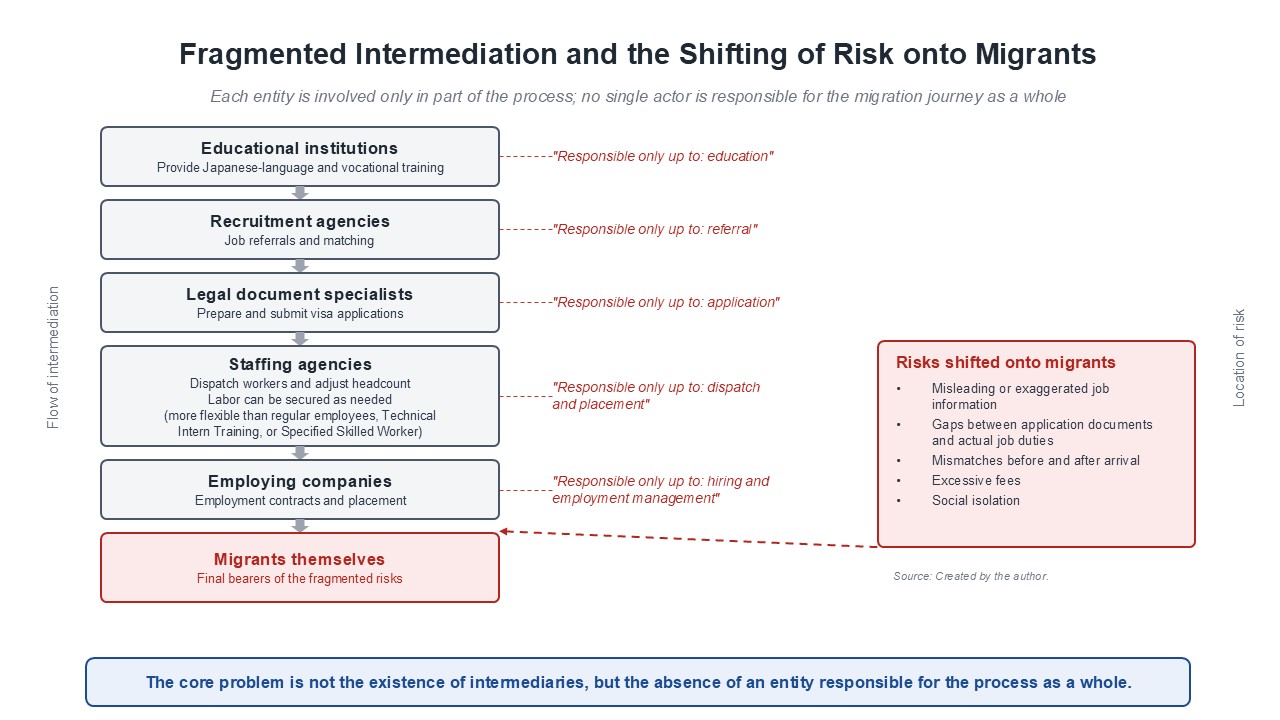
Source: Created by the author.
A system that connects migrants from departure to employment could, in principle, play a valuable role. The real issue is a structure in which no entity assumes responsibility for the entire process. Accepting workers under a framework that leaves responsibility unclear serves neither the migrants nor the communities in which they settle.
This dynamic raises the possibility that Gijinkoku could come to mirror the trajectory of the Technical Intern Training visa, which has long been criticized for the gap between its stated purpose of providing training as part of Japan’s international contributions and its actual function as a conduit for foreign labor. If Gijinkoku expands labor recruitment under the guise of professional employment, the consequences could be even more serious, given its connection to long-term settlement.
The challenges surrounding Gijinkoku are difficult to discern on the surface. In the Technical Intern Training category, the main institutional actors—supervising organizations, implementing companies, and sending organizations—are explicitly defined. And for Specified Skilled Workers, the status is clearly positioned as a labor‑shortage measure, with skill tests and Japanese‑language exams built into the framework. By contrast, Gijinkoku has not faced scrutiny because it is categorized as a professional or technical visa.
Pathways to Long-Term Residency Without Adequate Screening
Tightening visa requirements would not necessarily solve the problem. Labor demand currently absorbed by Gijinkoku holders would not disappear just because the system is made stricter.
First, pressure may shift toward more politically visible schemes, such as the Specified Skilled Worker or Training and Employment programs. Simply widening these channels, though, risks provoking political backlash.
Second, employers may start relying more heavily on international students attending domestic language schools, vocational schools, and universities. Yet enrollment in a Japanese educational institution does not guarantee real language ability or professional skills, and this would simply shift the problems associated with Gijinkoku into policy frameworks for foreign students.
Third, tightening entry could encourage less visible workarounds. Applications may become more sophisticated in presenting professional‑looking job descriptions, obscuring the gap between paperwork and reality.
In short, the answer is not simply stricter regulation. The real task is to redesign a system that can responsibly absorb the labor demand currently filled through Gijinkoku while strengthening enforcement at the same time.
If entry through Gijinkoku continues to expand, it risks creating what may be called “settlement without adequate selection”—pathways to long-term or permanent residency without credible skill testing, Japanese-language assessment, checks on job suitability, or meaningful structures for social integration.The concern here is not the prospect of more foreign residents but the absence of a framework defining what kinds of long-term residents Japan hopes to welcome, how their abilities should be verified, and what support will enable them to build stable lives in Japanese communities. These are not abstract questions; they require answers now because the underlying trends are already visible.
As long‑term residence and family reunification increase, host communities will inevitably need to shoulder responsibilities in education, healthcare, welfare, housing, childcare, and Japanese‑language support. These are essential investments for any society seeking to attract workers from abroad. But when the national visa system enables long-term settlement while leaving the practical support for daily life entirely to municipalities and local communities, it risks creating distrust in the system and friction on the ground.
Beyond Tighter Rules: Why the System Needs a Full Redesign
What Japan needs is not simply to widen or narrow the Gijinkoku pathway. Recent reporting has exposed a range of problems, from large‑scale nonpayment of wages in Aichi Prefecture to falsified applications prepared by legal document specialists.[5] But focusing only on these cases or treating Gijinkoku as a professional visa with pockets of misuse misses the larger issue. Over time, Gijinkoku has evolved into a multipurpose system, serving as a professional qualification, a route for international students into employment, a lifeline for regional small and midsize firms, and a bridge to long‑term settlement. Any serious discussion of reform must begin by recognizing this broader role.
If Gijinkoku is to be redesigned, at least three elements are essential. First, Japan needs a clear and credible way to assess applicants’ abilities at the point of entry. The system must verify the actual skills required for the work, Japanese‑language proficiency, and communication ability in the workplace. Second, responsibility after arrival must be clearly assigned so that risks are not pushed onto migrants themselves. A redesigned system must specify who is accountable for what, and at which stage. And third, because Gijinkoku can lead to family reunification and permanent residency, Japan needs a framework for social integration that anticipates long‑term settlement—one that includes not only employment but also family and children’s education, community life, and Japanese‑language learning.
None of this can be achieved if policies for foreign students, labor migration, and social integration continue to be treated as separate domains. They need to be rebuilt as a single, coherent system. In a society facing demographic decline, accepting more foreign residents is a realistic option, but it must be a policy for welcoming future members of local communities, not simply a strategy for filling labor shortages.
The question is not one of stricter regulation. It is whether Japan can design a migration policy that brings screening, support, and integration together, while anticipating both the contradictions that accumulate without regulation and the detours and new imbalances that emerge when regulation is tightened. What is needed is a shift away from counting foreigners as units of labor toward building a system that welcomes them as regular members of society.
Notes
[1] Statistics Bureau of Japan, “Reiwa 7‑nen Kokusei Chosa: Chosa no kekka” (Results of the 2025 Population Census), https://www.stat.go.jp/data/kokusei/2025/kekka.html.
[2] Immigration Services Agency, “Zairyu shikaku ‘Gijutsu, Jinbun Chishiki, Kokusai Gyomu’” (Residence Status “Engineer/Specialist in Humanities/International Services”), https://www.moj.go.jp/isa/applications/status/gijinkoku.html.
[3] Immigration Services Agency, “Reiwa 7‑nen 6‑gatsu matsu genzai ni okeru zairyu gaikokujin‑su ni tsuite” (Number of Foreign Residents as of the End of June 2025), https://www.moj.go.jp/isa/publications/press/13_00057.html.
[4] Because the Engineer/Specialist in Humanities/International Services status has no limit on the number of renewals, holders may continue renewing as long as their employer intends to maintain the employment relationship. To apply for dependent status, the sponsor must demonstrate that the spouse or child being brought to Japan is financially dependent on the sponsor and that the sponsor has sufficient income to support them. Permanent residence requires, among other conditions, at least 10 years of residence in Japan, including 5 years under a work or residence status, good conduct, and meeting the requirement for independent livelihood. See Immigration Services Agency, “Eiju kyoka shinsei 3” (Permanent Residence Application 3), https://www.moj.go.jp/isa/applications/procedures/zairyu_eijyu03.html.
[5] Aichi Labor Bureau, Ministry of Health, Labor, and Welfare, September 3, 2025, press release, “Rodo Kijunho ihan yogi de taiho, soken: Haken rodosha ni taisuru chingin fubarai no utagai” (Arrest and Referral for Suspected Violation of the Labor Standards Act: Alleged Nonpayment of Wages to Temporary Workers), https://jsite.mhlw.go.jp/aichi-roudoukyoku/content/contents/002373471.pdf.
TV Aichi, September 3, 2025, “Haken rodosha no 2‑kagetsu‑bun no chingin yaku 1,660‑man‑en o miharai ka: Rodo Kijunho ihan utagai de jinzai haken gaisha shacho o taiho, soken” (Temporary Staffing Company President Arrested and Referred for Suspected Violation of the Labor Standards Act: Approximately ¥16.6 Million in Unpaid Wages for Two Months), https://news.tv-aichi.co.jp/single.php?id=7853.
Chiba Nippo, December 22, 2024, “Betonamujin ni kyuyo miharai ka, Aichi: Susen‑man‑en ijo, taishikan ga chosa yosei” (Possible Nonpayment of Wages to Vietnamese Workers in Aichi; Embassy Requests Investigation, Amounts Exceed Several Tens of Millions of Yen), https://www.chibanippo.co.jp/newspack/20241222/1318769.
Yomiuri Shimbun, January 9, 2026, “Taiho sareta gyosei shoshi no otoko, Betonamujin yaku 50‑nin no nyukan tetsuzuki de jususha no kaisha‑mei o katte ni tsukatta ka: Broka kara suhyaku‑man‑en no hoshu” (Arrested Legal Documents Specialist Allegedly Used Names of More Than 10 Companies Without Permission in Immigration Procedures for About 50 Vietnamese Nationals; Received Several Million Yen from Brokers), https://www.yomiuri.co.jp/local/kansai/news/20260109-GYO1T00027/.
-
-

- Nonresident Senior Fellow
- Namiko Matsushita
- Namiko Matsushita
- Areas of Expertise
- Migration Policy/Labor Migration/High-Skilled Migration Policy/Labor Policy
- Research Project
-

Featured Content
-
Funding the Policies to Boost Japan’s Birthrate
Funding the Policies to Boost Japan’s Birthrate
-
Haiku: The Heart of Japan in 17 Syllables
Haiku: The Heart of Japan in 17 Syllables
-
Japan’s Population Decline and the Gijinkoku Visa’s Pathway to Settlement without Adequate Screening
Japan’s Population Decline and the Gijinkoku Visa’s Pathway to Settlement without Adequate Screening
-
The Perilous Decline of Japanese Agriculture
The Perilous Decline of Japanese Agriculture
-
The Pros and Cons of Japan's Rice Acreage-Reduction Policy
The Pros and Cons of Japan's Rice Acreage-Reduction Policy
