

- Review
Emergency Information as Public Infrastructure: 15 Years After the 2011 Tohoku Earthquake
April 10, 2026
|
KEY TAKEAWAYS |
Standing on the Hillside
The rebuilt town now extends from a hilltop in Rikuzentakata, a coastal city in Iwate Prefecture. Fifteen years ago, in the immediate aftermath of the Great East Japan Earthquake, this location served as my base of operations as a television journalist, from which we broadcast and coordinated coverage. I have returned many times; however, on this visit, I stand here as a private citizen rather than as a reporter.
The neighborhoods along the Kesen River that were destroyed by the tsunami have since been cleared and resettled. Vacant lots once dotted the landscape, but over time, exposed earth gave way to vegetation. Looking out over Hirota Bay at the river's mouth, memories from that day return unbidden.
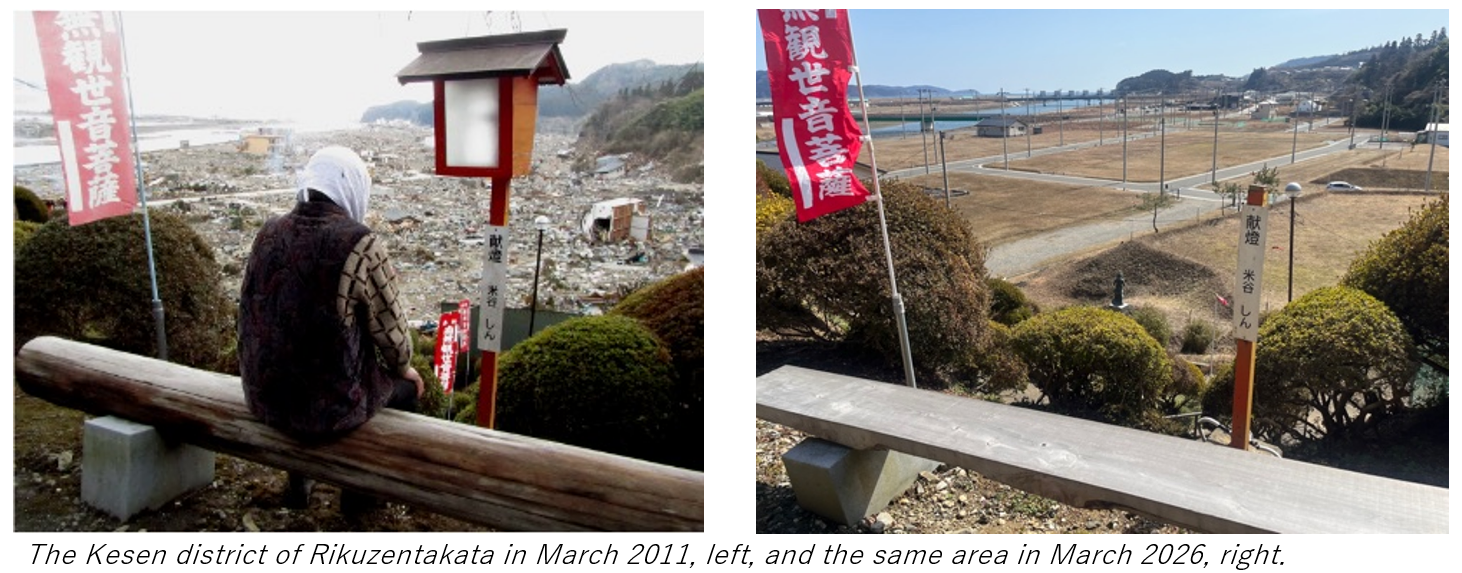
The landscape has changed over time; however, the question of what determined survival—and what shaped individual responses—remains each time I return.
Over time, my focus shifted from the scale of destruction to the factors that differentiated those who evacuated immediately from those who did not. Some individuals did not perceive the warnings as urgent, and prior experiences led them to underestimate the threat. However, this was not the only factor; a more fundamental issue was that some individuals never received the information at all.
Drawing on my experience reporting in the disaster zone, I examined how information reached—or failed to reach—affected populations and the consequences of these gaps. I then consider the institutional frameworks and communication infrastructures that shape information delivery, as well as the reforms that may now be required.
What the Debris Concealed
I have long been uncomfortable with the term “debris” to describe what I witnessed in the immediate aftermath of the disaster. What lay scattered across the landscape was not merely rubble, but remnants of disrupted lives. The dish cabinets held bowls, clothing remained folded in drawers, and belongings drifted ashore. Waterlogged photo albums preserved the memories of families, even as they lay scattered across the area. Among these, photographs were the one item I found impossible to leave behind.
Whenever we found photographs, we collected them and designated a space at evacuation shelters—marked with a simple sign reading “Photographs Found Here”—where survivors could come to search. Over time, this space became a quiet gathering point for survivors. Collecting these photographs was not a professional obligation; it was a human response.
In large-scale disasters, most possessions are processed and removed; however, photographs and albums function as records of family history. This impulse later led me to recover another form of memory from the wreckage.
While reporting in a tsunami-affected neighborhood, I discovered a mud-caked VHS tape among the debris. A label on its spine read: “Child’s Growing Up—Vol. 13.” Under normal circumstances, removing items from a disaster site is prohibited. However, the same impulse that led me to collect photographs compelled me to act. Heavy machinery had already begun clearing the area, and the site would soon be emptied. I picked up the tape.
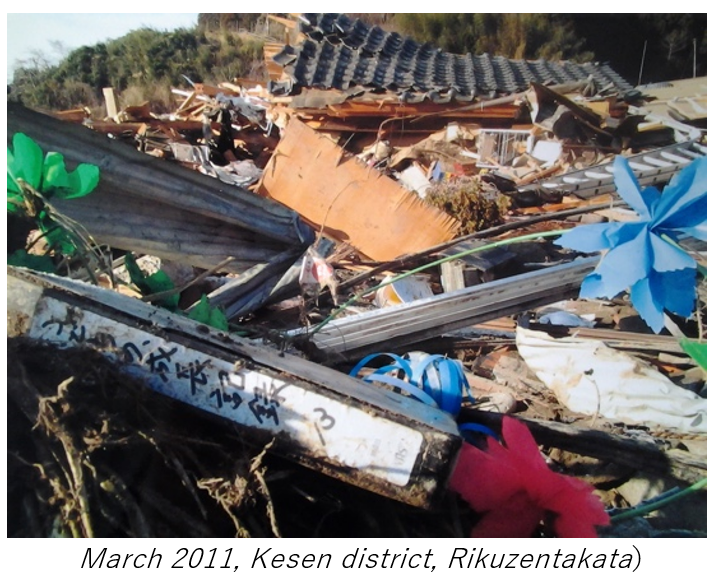
Recovering the Tape
Restoring a VHS tape saturated with saltwater and mud is a technically complex process. The television station's technical team determined that the restoration was beyond their operational capacity. With limited expectations, I contacted the manufacturer; however, the response was unexpected.
“If our technology can assist those affected by this disaster, we will do everything possible.”
This response led to an unprecedented effort to recover a submerged VHS tape. Technicians carefully separated the fused layers of tape and manually cleaned the magnetic surface to preserve the recorded data, an exceptionally meticulous process.
When the footage was finally recovered, it depicted a girl growing from primary school through junior high school. In one scene, recorded at a school arts festival, children stood on a stage singing “Smile Again,” a song about overcoming hardship and envisioning a hopeful future.
In another segment, she recited Shuntaro Tanikawa’s poem On Being Alive, reflecting on the immediacy and significance of existence.
This footage was recovered in the immediate aftermath of the disaster that claimed many lives. What it contained was not merely a record, but a representation of the texture of everyday life that the disaster had erased. However, the footage did not belong to us; it belongs to its owner, whom we sought to identify.
The only lead was a name spoken during a graduation ceremony captured on the tape. Because the tsunami had destroyed the neighborhood where the tape was found, we had no information about the family's whereabouts or survival. We began making inquiries in the surrounding area, speaking with residents and contacting schools to trace her identity. Several days later, we located her.
She was nineteen years old and training to become a care worker at a vocational college. On the day of the disaster, she had been at a nursing facility along the Miyagi Prefecture coast. As the tsunami struck during her evacuation, she was swept upward and survived by clinging to a ventilation opening near the ceiling.
After watching the footage, she described it as “the courage to keep living—a gift from my seven-years-younger self.”
The Ethics of Telling the Story
Her response prompted us to consider whether the footage should be broadcast as a documentary. Following extensive discussions with her and her parents, and with their consent, we began developing the story. However, we soon received a call from her younger brother, then a high school student, who objected to the broadcast.
“People around us lost relatives and friends. Please don’t turn my sister’s survival into a heartwarming story.”
His objection underscored the risk that editorial decisions, even when well-intentioned, could impose additional emotional burdens on others. We suspended production and decided not to broadcast the footage.
A few days later, her father contacted us and reversed this decision.
“If this can provide hope to other survivors, please broadcast it. I will speak to my son myself.”
Even within the newsroom, consensus remained elusive. Questions emerged regarding consent from the many children visible in the footage, the adequacy of anonymization measures such as face blurring, and the ethics of removing the tape from the disaster site. Ultimately, the decision to broadcast was guided by the principle, embedded in Japan's Broadcasting Act, that public broadcasting serves the public interest by providing essential information to society.
This experience raised two key questions: What is disaster journalism obligated to convey, and what is the value of information—however carefully gathered and authentically presented—if it fails to reach its intended audience?
The Gap Between Transmission and Reception
In the immediate aftermath of a major disaster, communication systems become highly fragile, and the channels through which affected residents receive critical information are often severely constrained.
During the Great East Japan Earthquake, terrestrial television broadcasts continued; however, the tsunami destroyed receivers in the most heavily affected households. Mobile phone networks were both overloaded and inaccessible, further limiting communication. In this context, portable devices such as handheld radios and car radios, along with municipal emergency loudspeakers and bulletin boards at government offices and evacuation shelters, became the most reliable sources of practical information.
This situation reveals a fundamental asymmetry: the volume of information transmitted by senders is not equivalent to the volume actually received by the intended audiences. Information cannot function without accessible means of reception. The value of disaster information is determined not by what is transmitted, but by whom it reaches.
Affected residents did not require a comprehensive overview of national conditions; rather, they needed highly localized, actionable information. This included information within a limited geographic radius: locations for food and supply distribution, available medical facilities, access to bathing services, volunteer registration points, the operational area of the Self-Defense Forces, and the status of family members. The value of information lies not in its breadth, but in its immediate relevance to survival and decision-making.
This illustrates what I define as the “reach problem.” Information does not become actionable through speed or volume alone; it becomes actionable when it enters an individual's immediate context and informs a specific decision.
Designing Information Systems for Crises
During disasters, a wide range of actors springs into action, including the Self-Defense Forces, local governments, social welfare councils, NGOs, and private sector entities. Organizations such as the Nippon Foundation also play a significant role by providing financial and operational support to local governments and civil society organizations. However, the mere existence of assistance is insufficient if affected populations are unaware of it.
When support information is not effectively shared across government agencies, aid organizations, and local media, it becomes fragmented and fails to reach intended recipients. The challenge is not merely to improve the content of disaster reporting, but to treat disaster communication as an integrated public system. Such a system must define responsibility for information management, determine appropriate distribution channels, and establish clear institutional roles. This requires deliberate institutional design rather than ad hoc coordination.
Another critical dimension cannot be addressed through technology alone. Information delivered through trusted, familiar sources is more likely to be received as personally relevant and to prompt action. Trust is not determined by the scale or reach of a media outlet; rather, it is cultivated through consistent, everyday engagement with communities.
Both comprehensive national-level information and locally grounded, neighborhood-scale information are necessary; neither alone is sufficient for effective evacuation decision-making. Disaster communication is not simply a matter of speed; it is fundamentally a question of whether community-embedded information systems are sufficiently robust to ensure that warnings are received, understood, and acted upon.
Japan's Current Warning Infrastructure
15 years after the disaster, many local governments in Japan have significantly strengthened their early warning systems. Alerts issued by the Japan Meteorological Agency are now transmitted through the national J-Alert system to local authorities almost simultaneously with their release, and are subsequently relayed to residents via municipal emergency broadcast networks and mobile phone notifications. Additional parallel channels, including social media platforms and email subscription services, have further expanded the pathways through which residents receive information.
This represents meaningful progress; however, it addresses only one dimension of the broader challenge.
The Coming Contraction of Local Media
Japan's broadcasting sector is entering a period of structural consolidation, with the number of regional television stations and local bureaus expected to decline. This trend is often framed primarily as an issue of media economics or industrial restructuring; however, it raises urgent concerns regarding disaster resilience.
A reduction in local media presence results in fewer points of routine contact between media organizations and the communities they serve. The editorial judgment that enables effective local disaster coverage—such as identifying overwhelmed shelters, passable roads, and isolated villages—is developed through sustained everyday engagement with these communities. This form of knowledge cannot be easily transferred to centralized operations. Nor can the trust that leads residents to interpret warnings as personally relevant be easily replicated.
Consequently, the contraction of local media infrastructure represents not only a decline in reporting capacity but also a weakening of the mechanisms through which critical information reaches residents. This process undermines the ability of information to reach residents in a timely, relevant, and trusted form. In such conditions, information may be widely broadcast yet fail to reach those who need it most.
Toward a Policy Framework
What is required extends beyond debates on broadcast regulations or media consolidation. Local governments and media organizations should establish routine coordination mechanisms, including joint exercises, formalized information-sharing protocols, and clearly defined roles for crisis conditions, rather than attempting to improvise such arrangements during emergencies. The maintenance of local media infrastructure should be treated as a shared societal responsibility.
Disaster information transmission should not be confined to sector-specific policy domains such as broadcasting or emergency management. Rather, it should be recognized as a foundational component of the infrastructure that sustains civic life, including the basic act of evacuating in response to warnings.
Ultimately, the determining factor in whether disaster warnings reach populations is not the sophistication of transmission technologies. Instead, it lies in the maintenance of trust between information providers and the communities they serve, as well as in the deliberate design of systems that ensure this trust remains effective under emergency conditions.
The fifteen years since the Great East Japan Earthquake have not elapsed simply for memories to fade. Instead, they compel us to re-examine the conditions necessary for information to reliably reach residents.
-
-

- SENIOR POLICY RESEARCH OFFICER
- Natsuhei Eno
- Natsuhei Eno
- Areas of Expertise
-
- Media theory (audiovisual semiotics)
- Broadcasting law (crisis management)
- Strategic policy messaging
- Policy implementation design
-

Featured Content
-
Haiku: The Heart of Japan in 17 Syllables
Haiku: The Heart of Japan in 17 Syllables
-
Funding the Policies to Boost Japan’s Birthrate
Funding the Policies to Boost Japan’s Birthrate
-
Japan’s Population Decline and the Gijinkoku Visa’s Pathway to Settlement without Adequate Screening
Japan’s Population Decline and the Gijinkoku Visa’s Pathway to Settlement without Adequate Screening
-
The Two Income Barriers: How Do We Address Them?
The Two Income Barriers: How Do We Address Them?
-
The Perilous Decline of Japanese Agriculture
The Perilous Decline of Japanese Agriculture
